Drip tip: what weeks of daily use do to it
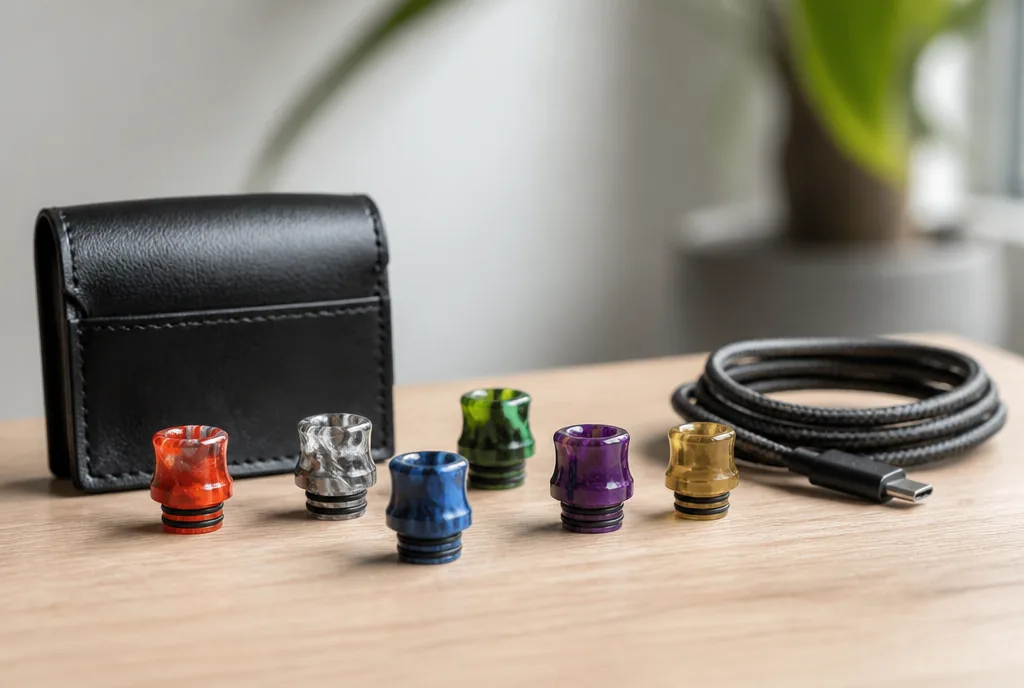
On the day you buy it, a mouthpiece is judged in three seconds. The colour works, it feels about right against the lips, decision made. Six weeks later the verdict has nothing in common with that. A drip tip that has started to move, a resin that has lost its depth, a deposit you can no longer shift: that is what vapers actually talk about once the novelty has gone.
What a drip tip really becomes over the weeks
A drip tip almost never breaks. It degrades in small increments, and that is exactly what makes the wear hard to spot before it starts to annoy you.
User reports and specialist forum threads converge on three things. The o-ring loses its firmness, the surface marks or dulls, and a greasy film eventually settles inside the internal channel. None of those three faults stops you vaping. Together they are enough to make a setup unpleasant without your quite knowing why.
The pattern repeats from one model to the next whatever the price bracket. The symptoms rarely appear at the same pace, but they almost always arrive in the same order, and recognising them early saves a lot of pointless coil changes.
The wear signs vapers report most often
The first signal, and the one cited most, is play at the base. A mouthpiece that was perfectly firm starts to swivel a quarter turn under the thumb, then to lift slightly as you pull the device away from your lips.
The cause is the silicone o-ring, permanently compressed, gradually losing its elasticity. The failing part is therefore not the mouthpiece at all but a small replaceable seal, which is worth knowing before condemning the whole thing.
Next comes appearance. Coloured resins dull, polished surfaces pick up micro scratches, and anodised finishes lighten wherever teeth make contact. That ageing is cosmetic and does not affect the draw in any measurable way.
Several test reports note that translucent shades mark fastest, with e-liquid and daylight working on the tint together. Dark or opaque finishes hold their look considerably longer under the same treatment.
The third sign is the most insidious. Through repeated condensation, a viscous deposit lines the inside of the mouthpiece, holding the flavours of previous e-liquids and blurring whatever bottle you are running now. Most people blame the coil or the juice long before they think of the mouthpiece.
What the material changes as a drip tip ages
Not every material ages the same way, and the gap opens precisely where product listings stop. What you gain in thermal comfort is sometimes paid for in fragility. The table below summarises what users report on the most common families.
| Material | What ages well | What causes problems |
|---|---|---|
| Stainless and brass | Mechanical strength, easy cleaning | Visible scratches, carries heat |
| Cast resin | Comfort in the mouth, insulation | Tint dulls, sensitive to solvents |
| Delrin and POM | Very stable, immune to flavourings | Flat look from the outset |
| Ultem | Handles heat and repeated cleaning | Scratches faster than it appears |
| Soft silicone | Gentle, no risk of cracking | Deforms and holds odours |
The sharpest divergence concerns cleaning products. A metal mouthpiece takes isopropyl alcohol without harm, whereas the same operation repeated on a cast resin can cloud it permanently. For resins, warm soapy water remains the only genuinely risk free routine.
The point at which a drip tip starts to annoy
There is a threshold, hard to date but easy to recognise, where the accessory stops being a detail and becomes a daily nuisance. Reported experience puts it in almost exactly the same place every time.
The most cited trigger is not looks but liquid coming back up. Once a slackened mouthpiece lets droplets reach the lips two or three times a day, tolerance collapses very quickly indeed.
Then comes noise. A faint whistle that has appeared gradually nearly always signals imperfect seating rather than an airflow fault. You notice it in a quiet room in the evening, and it becomes irritating fast.
The third trigger is smell. A mouthpiece that has held the memory of a menthol liquid for three weeks ends up interfering with every new flavour you try after it, which is a slow and thoroughly confusing form of disappointment.
Maintaining a drip tip to push the deadline back
Maintenance genuinely changes perceived lifespan, provided it is regular rather than aggressive. The habits reported by long term vapers come down to a handful of simple gestures.
- Rinse the mouthpiece in warm water once a week, then dry it completely before refitting.
- Switching away from a heavily flavoured liquid calls for a clean, not just a rinse.
- Keep the original o-rings from old mouthpieces, they are free spare parts.
- Avoid leaving hardware in a car in full sun, since heat accelerates deformation of soft materials.
- Run a dry cotton bud through the internal channel whenever you change a coil.
One technical point stays widely ignored and is worth more than any amount of scrubbing. O-rings are sold in mixed diameter packs at specialist shops, which lets you restore the original firmness of a mouthpiece you had written off entirely.
How fast the gunk builds up also depends heavily on the atomiser underneath. An open deck produces noticeably more condensation, as described in the feedback gathered after weeks on a dripper, so the same mouthpiece can need very different attention on two different setups.
When to replace rather than clean
Some faults cannot be recovered, and persisting costs more time than fitting a new part. Three cases are clear cut in reported use.
A crack in a resin, however fine, widens and eventually creates a parasitic air leak. A metal mouthpiece whose seat or thread has been marked will never sit properly again. And a silicone mouthpiece that no longer springs back after compression has reached the end of its service.
In every other case, a fresh seal and a proper clean return the accessory to something very close to its original state. That is a far better outcome than the usual reflex, which is to blame the coil and change it early.
Frequently asked questions
How long does a mouthpiece keep its original colour?
That depends mostly on light exposure and on the type of liquid. Reports point to faster dulling on pale and translucent resins than on dark or opaque shades.
Can a second hand mouthpiece really be brought back?
On the hygiene side, hot soapy water and a new o-ring are enough. Mechanically, a damaged thread or a marked seating face stays beyond recovery.
Should the mouthpiece be rotated occasionally to wear it evenly?
Plenty of vapers do it out of habit, particularly on flat profiles. The effect on tooth marks is real, the effect on the seal is negligible.
Does a long serving mouthpiece change the flavour?
Yes, once a deposit has formed in the channel. The effect disappears after a full clean, which is a useful way to tell a mouthpiece problem from a coil problem.
Is a more expensive model likely to last longer?
Cost does not predict longevity. The materials that hold up best over time, Delrin among them, sit at the plainest end of the catalogue.
Making a drip tip last: what use teaches
Three lessons come out of this accumulated feedback. The o-ring is the real consumable, the material governs ageing far more than the brand does, and regular cleaning beats aggressive cleaning every time.
A drip tip looked after that way passes through several coil cycles without difficulty, and it is usually boredom with the look rather than genuine wear that decides its replacement. That is what makes the part worth watching: it concentrates in miniature everything that vaping hardware reveals with time, the same pattern seen on a pod mod after several months of daily use and across the rest of what we publish over time.
Editorial content for adult readers only. Vaping products usually contain nicotine, a substance that causes addiction. Not for sale to under-18s in the United Kingdom. This article is not a buying recommendation.
Keep reading
Voopoo Drag X3: what it becomes months later
The Voopoo Drag X3 months in: pod and coil wear, charging port, fire button, removable cells and consumable supply. What to watch, and what to check first. Over time
 Geekvape Aegis Legend 5: what lasts, what wears
Lock switch, LEDs, cells, the 80 per cent charge cap: what reported use says about the Geekvape Aegis Legend 5 once the first weeks are behind it. Feedback d'Usage